
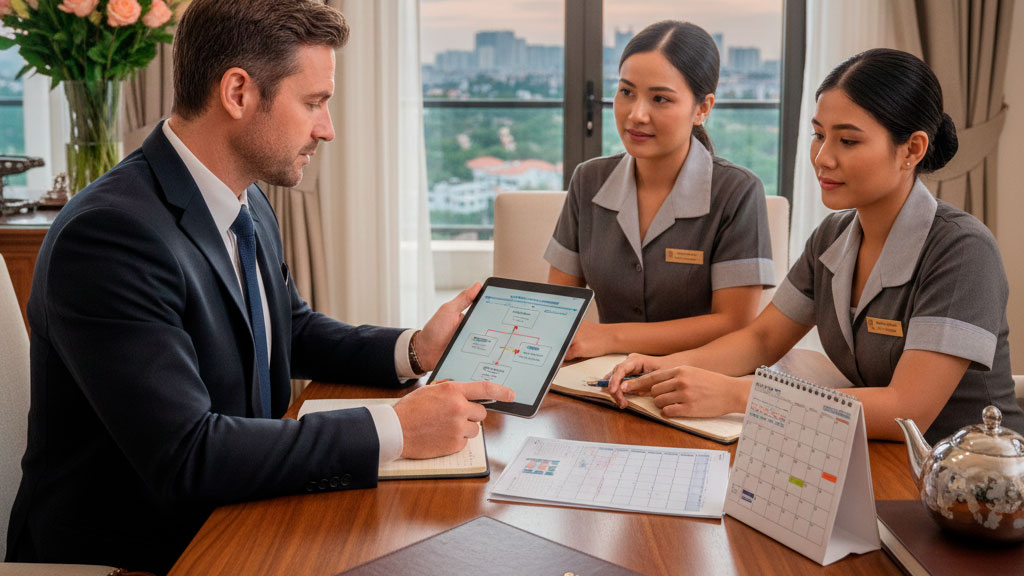
The success of a working relationship within the home does not depend solely on the employee’s skill, but on the employer’s clarity. In high-end domestic service, where the line between professional and personal can become blurred, establishing precise limits and functions is the foundation of a harmonious coexistence. When hiring elite professionals, such as those represented by Luxury Nepalese Agency, transparency from day one not only facilitates the staff’s work but ensures that the household operates like a perfectly oiled machine.
The master document: the household manual
Improvisation is the greatest enemy of domestic efficiency. A luxury home requires a business-like approach to its management, beginning with the formalization of tasks.
Creating a dynamic job description
Assigning a title is not enough. It is essential to draft a document detailing areas of responsibility: from the maintenance of delicate textiles to the management of technological inventories. A dynamic job description should evolve with the family while maintaining a core structure. For Nepali or Filipino staff, who value order and hierarchy, having a clear map of their duties allows them to perform their functions with the confidence that they are meeting exactly what is expected of them.
Establishing quality standards (SOPs)
Standard Operating Procedures (SOPs) are step-by-step instructions on how to perform specific tasks. How should coffee be served? Which products are used for Carrara marble? Defining the “how” in addition to the “what” eliminates guesswork. By setting these quality expectations, the employer provides the psychological tools necessary for the staff to achieve excellence without friction or misunderstandings.
Schedules, breaks, and availability
Clarity in time is as important as clarity in task. Defining work schedules, rest periods, and protocols for overtime is vital to prevent burnout. A professional who knows when their day ends and when their recovery time begins will be much more productive and maintain a more positive attitude. In live-in service, physically and temporally delimiting moments of privacy is essential for the longevity of the employment relationship.
Communication and Interaction Protocols
Once tasks are defined, the next step is to establish how information will flow within the house. Communication is the lubricant that allows roles to be performed without noise.
Official communication channels
In the digital age, it is easy to fall into the chaos of text messages and emails. It is recommended to establish an official channel: a home management app, a physical logbook, or a brief weekly meeting. This prevents instructions from getting lost and allows staff to report incidents (such as a breakdown or lack of supplies) formally, allowing the employer to make decisions based on accurate information.
Privacy and etiquette protocols
In high-standing households, discretion is the supreme value. Defining clear expectations about privacy—which areas are restricted, how to interact with guests, or the handling of confidential information—must be part of the initial induction. Luxury Nepalese Agency professionals stand out for their innate discretion, but reinforcing the specific protocols of each family ensures that staff feel secure respecting the boundaries of the home’s intimacy.
Performance evaluation and constructive feedback
Defining roles is not a one-time event, but an ongoing process. Feedback allows expectations to be adjusted to the day-to-day reality.
The weekly feedback system
Establishing a brief 10-minute meeting at the start of the week helps align objectives. This is the time to review the family’s agenda (trips, dinners, visits) and adjust staff responsibilities accordingly. This practice reduces employee anxiety regarding the unforeseen and ensures the home is prepared for any event.
Error management and improvement opportunities
When expectations are not met, the key is constructive communication. Instead of general criticism, specific points should be pointed out based on previously defined roles. “Do you remember the protocol for silverware care? I noticed this step is missing…”. This approach maintains professionalism and focuses the conversation on the technical solution rather than a personal failure, which is especially important for maintaining the motivation of Nepali and Filipino staff.
Incentives and recognition of merit
A role well performed deserves recognition. Defining what constitutes “outstanding” performance and how it will be rewarded (bonuses, additional days off, specialized training) motivates staff to exceed basic standards. Recognition reinforces loyalty and turns the employee into a true partner in managing the household’s well-being.
Conclusion
Setting clear expectations is the most important act of leadership an employer can perform. By precisely defining roles and responsibilities, ambiguity is eliminated, stress is reduced, and the door is opened to the highest quality service. At Luxury Nepalese Agency, we not only provide the most qualified talent but also advise our clients so that this integration process is flawless. A home where every member knows what is expected of them is a home that breathes order, respect, and, above all, peace of mind for the family.