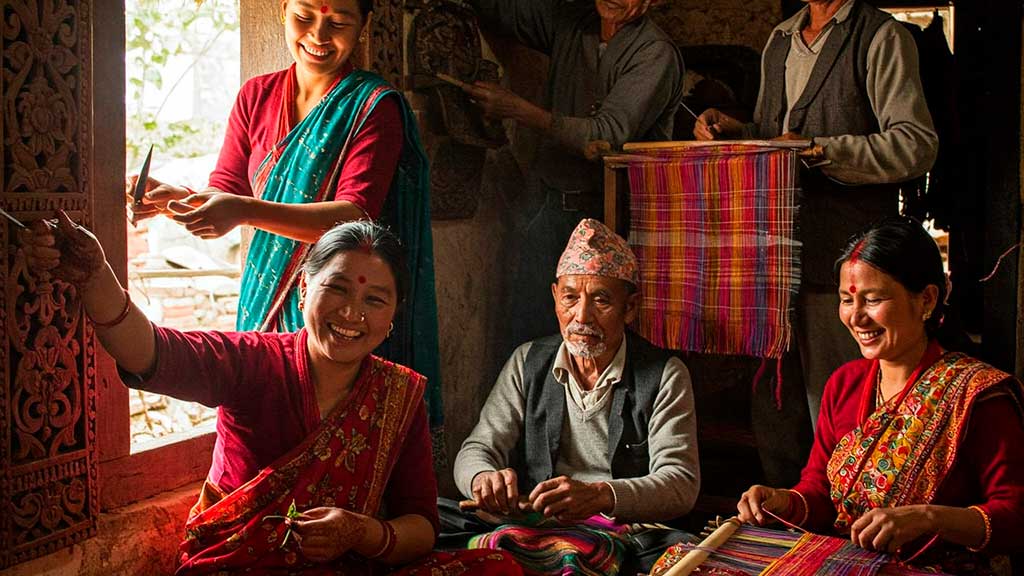
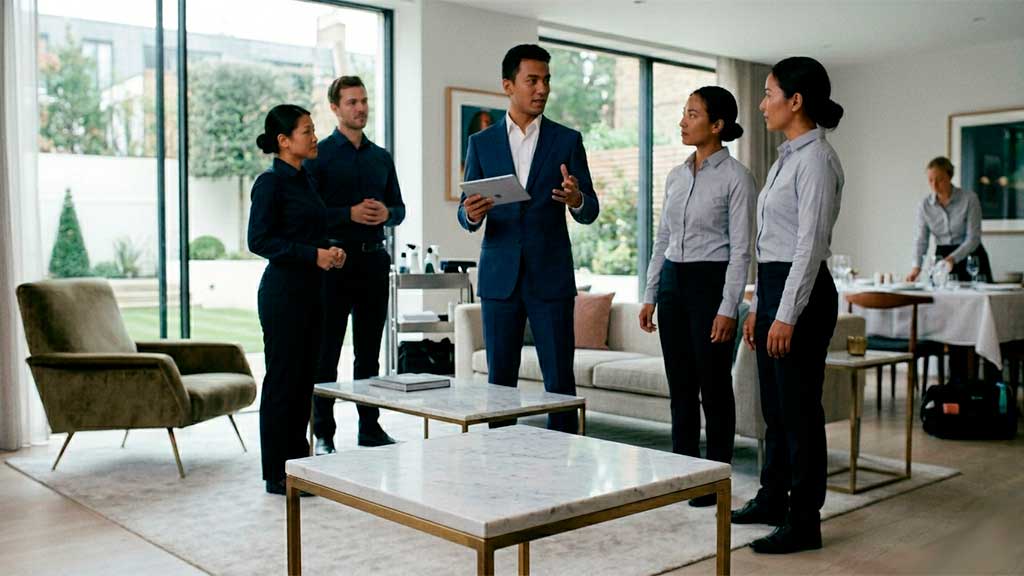
Managing a large-scale residence is not much different from running a luxury boutique hotel. When the domestic team grows to include multiple profiles such as housekeepers, butlers, chefs, nannies, and chauffeurs, goodwill and a positive attitude are no longer enough. In these environments, logistical complexity demands a solid organizational structure and clear leadership. Nepali staff, renowned for their discipline and teamwork capabilities, excel within these complex structures, but their success largely depends on efficient management. Below, we analyze the key strategies to transform a large property into a seamless machine of service and well-being.
Structure and operational organization: designing the system
In households with multiple employees, the most common mistake is a lack of definition. If responsibilities overlap, conflict arises; if gaps are left, the service suffers. Efficiency begins with a prior structural design.
Clear definition of roles and lines of reporting
Every member of the team must know not only their tasks but also their position within the household hierarchy. In large-scale residences, it is vital to establish who reports to whom. Is there a House Manager, or does the employer manage each employee directly? Defining these lines of authority prevents staff from receiving contradictory orders, which generates stress and decreases productivity. Nepali staff, who deeply value respect for hierarchy, perform at their best when instructions flow through a clear, established channel.
Standard operating procedures and “the house bible”
Excellence in luxury lies in consistency. A large home cannot depend on the mood or memory of the staff. Creating a procedures manual is indispensable. This document should detail everything from how flowers should be arranged in the living room to the exact protocol for receiving guests or the specific care of fine materials (marble, exotic woods, or delicate fabrics). These manuals ensure that, in the event of any replacement or turnover, the quality of service remains unaltered, providing the staff with a clear roadmap to achieve perfection.
Communication and leadership in team management
Once the system is established, the engine that drives it is communication. In a property of thousands of square meters, disconnection is the enemy of efficiency.
Internal communication channels and coordination meetings
Improvisation is the antithesis of luxury service. For large households, we recommend establishing brief daily or weekly coordination meetings. In these sessions, the family’s schedule, scheduled visits, and extraordinary maintenance tasks are reviewed. In addition to face-to-face meetings, utilizing technological tools (task management applications or professional communication groups) ensures that information flows in real-time. An informed team is a proactive team that can anticipate the family’s needs before they even manifest.
Managing shifts, rest periods, and staff rotations
Fatigue is the primary cause of errors in service. In homes that require 24/7 coverage, shift planning must be millimetrically precise. It is essential to balance working hours with adequate rest periods that allow for physical and mental recovery. When managing Nepali staff, who typically possess an untiring work ethic, the employer must be the one to ensure these rest periods are respected. A well-rested team maintains the attention to detail and the positive attitude necessary for direct interaction with the family and their guests.
The role of technology and the agency in operational efficiency
Modernizing household management is the final step toward achieving total efficiency. Integrating digital tools and having the backing of external experts makes the difference between a house that simply functions and one that truly shines.
Digitization of household management and inventory control
Using specialized software for estate management allows for comprehensive inventory control of wine cellars, pantries, linens, and cleaning supplies. This not only avoids unnecessary purchases but also ensures that essential items are never lacking. Technology also facilitates the tracking of preventive maintenance for the property (climate control, security systems, swimming pools), preventing costly breakdowns that interrupt family life. Training staff to use these digital tools elevates their professional profile and improves the traceability of every action taken in the house.
The importance of partnering with a specialized agency
Even the best-designed system needs adjustments over time. An agency like Luxury Nepalese Agency acts as a long-term strategic partner. We not only handle the rigorous selection of profiles that best fit your structure, but we also offer consultancy on team organization. Our ability to understand both the owner’s needs and the culture of the Nepali staff allows us to mediate in process optimization, ensuring that harmony and efficiency always go hand in hand.
Performance evaluation and continuous improvement
Efficient management is a living process. Implementing periodic performance evaluations allows for the identification of bottlenecks and the recognition of employees who exceed expectations. These evaluations should be viewed as an opportunity for the professional growth of the team rather than as a control tool. By encouraging continuous improvement, staff feel that their work has a purpose and that their evolution is part of the global success of the household.
Conclusion
Managing a large home requires the vision of a Chief Executive Officer. By combining a clear organizational structure, fluid communication, and advanced technology, the property owner can delegate daily operations with complete confidence. Nepali staff, with their loyalty and adaptability, are the perfect allies to execute this vision of excellence. At Luxury Nepalese Agency, we know that efficiency not only saves time and resources; above all, it provides the most coveted luxury: the peace of mind that comes from knowing your home is in the best hands, running with the precision of a Swiss watch and the warmth of exceptional human service.